

Featured
Artificial Intelligence Adoption in Nuevo León: Level, Context, and the Gap with Mexico
The national average describes a trend; adoption decisions happen company by company, sector by sector, and region by region.
Read analysisPlatonica Presence analyzes how industrial commercial information influences a company's costs and decisions, evolves alongside sector requirements, and is reinterpreted by search, digital platforms, and artificial intelligence.
Each article turns ongoing research, experience in industrial environments, and market observation into clear, applicable knowledge.
The national average describes a trend; adoption decisions happen company by company, sector by sector, and region by region.
Read analysisFoundations, definitions, models, and the evolution of the category.
Read analysisHow information changes, fragments, and loses consistency over time.
Read analysisWhat buyers, organizations, and systems need to understand and verify a company.
Read analysisHow digital environments interpret, connect, and present information.
Read analysis
Nuevo León reports 12.6% artificial intelligence adoption among companies with ten or more employees, compared with an 8.0% national average. The figure shows a regional gap, not uniform transformation.
Read analysis
Industrial company information is distributed across owned sources, external platforms, registries, search engines, and AI systems. Each environment carries a different responsibility.
Read analysis
Impulsora de Innovación México uses co-investment to back companies in AI, advanced manufacturing, and other strategic sectors. What the program offers—and expects.
Read analysis
Mexico is preparing a specialized spectrum model for smart networks in manufacturing, logistics, and other productive sectors. Public consultation has ended; the infrastructure has not yet been deployed.
Read analysisCommercial Information Infrastructure is the system of public information that enables a company to be found, understood, and verified by people, organizations, and technologies.
It includes the way capabilities, products, services, evidence, locations, and operational changes are structured, connected, and maintained over time.
Identify which part of your public information needs attention first and receive an immediate score.
Browse all publications by date and editorial route.
Nuevo León reports 12.6% artificial intelligence adoption among companies with ten or more employees, compared with an 8.0% national average. The figure shows a regional gap, not uniform transformation.
Read analysis
Industrial company information is distributed across owned sources, external platforms, registries, search engines, and AI systems. Each environment carries a different responsibility.
Read analysis
Impulsora de Innovación México uses co-investment to back companies in AI, advanced manufacturing, and other strategic sectors. What the program offers—and expects.
Read analysis
Mexico is preparing a specialized spectrum model for smart networks in manufacturing, logistics, and other productive sectors. Public consultation has ended; the infrastructure has not yet been deployed.
Read analysis
Adopting AI is not only about choosing a tool. A reliable workflow needs a defined problem, known inputs, accountable owners, review points, and evidence for deciding whether to scale.
Read analysis
A Commercial Visibility Audit looks at how a company appears and is represented across its public sources. An incomplete or outdated presence doesn't prove a weak operation; it reveals the distance between the company that exists and the information available to describe it from outside.
Read analysis
Mexico is already a relevant manufacturing platform, but artificial intelligence adoption remains limited and uneven. A Centro México Digital study based on the 2024 Economic Censuses found positive associations among adoption, production, compensation, and employment, not causal guarantees. For companies, the challenge combines internal implementation with accurate public representation of the technology capabilities they can actually demonstrate.
Read analysis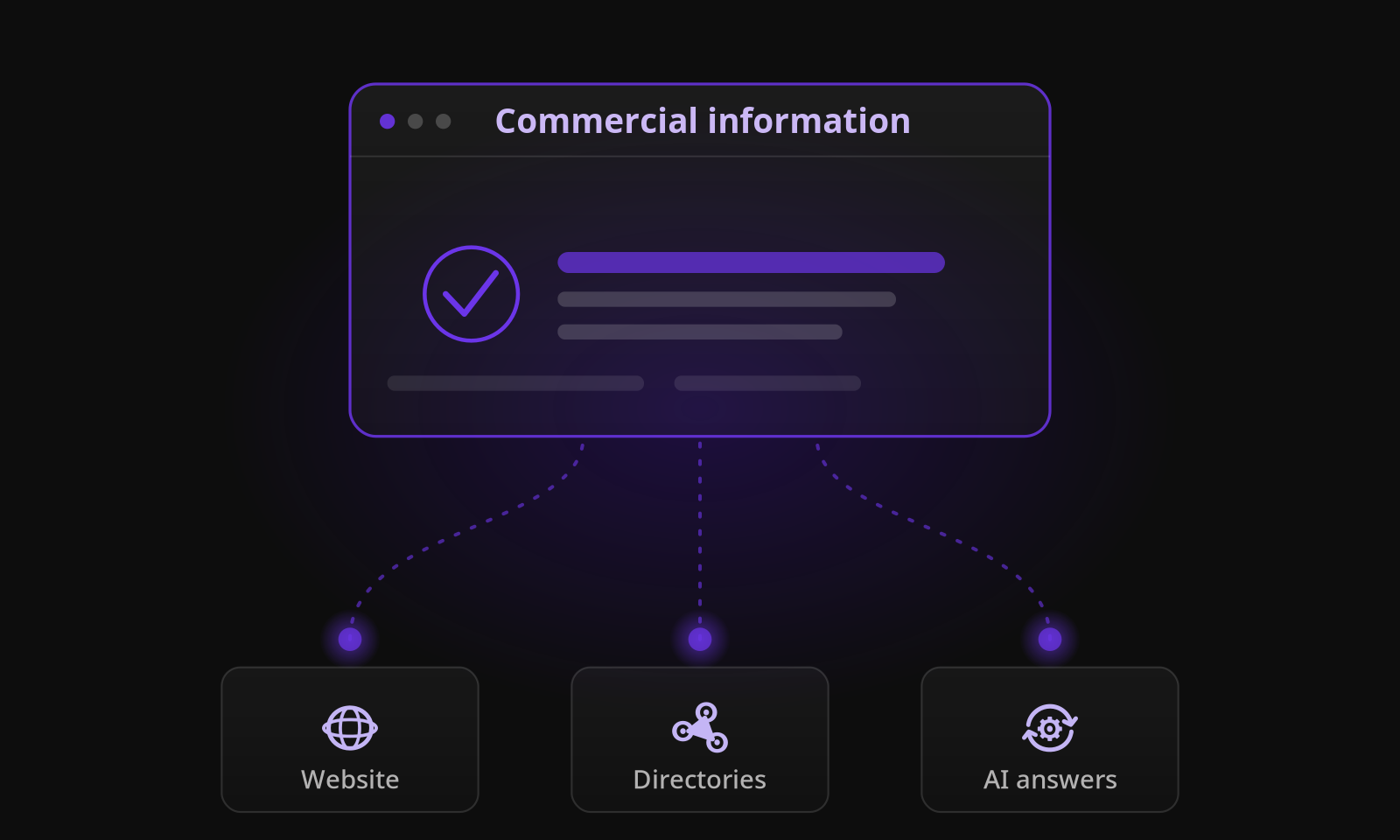
A company's commercial information does not live in one channel. Websites, search, directories, and AI-generated answers all depend on an organized, verifiable foundation that stays aligned with the operation.
Read analysis
Commercial information ages when it stops matching the operation it is meant to represent. Continuity is not solved by one isolated update. It requires approved sources, accountable owners, and rules for carrying each change across the website, documents, profiles, and other assets.
Read analysis
The Mexico Plan created tax incentives for new investment, training, and innovation. The opportunity is relevant to industry, but percentages and requirements depend on the asset, fiscal year, and each taxpayer’s circumstances.
Read analysis
An industrial website does not replace a technical review or a conversation with engineering. It can reduce uncertainty before contact. To do that, it must explain what the operation does, under which conditions, what evidence supports it, and which information requires direct validation.
Read analysis
Plant capacity does not automatically become useful information for a buyer. To support an initial evaluation, a company needs to explain what it can do, under what conditions, what evidence supports it, and which points require direct confirmation. Making the operation visible does not mean publishing everything; it means accurately representing what the company can substantiate.
Read analysis
On July 1, 2026, the United States, Mexico, and Canada conducted the first joint review of the USMCA. The United States did not agree to renew it in its current form, but the agreement did not expire. It remains in force while negotiations continue. For industrial companies, the relevant change is not an assumed automatic search for new suppliers, but an environment in which origin, identity, capacity, and evidence may require more careful verification.
Read analysis
NMSDC's MBE certification provides verification, credibility, and visibility within its network, but it does not guarantee contracts or control purchasing decisions. The task is not to replace certification with marketing. It is to keep the credential current, accessible, and consistent with the public information that helps others understand the company.
Read analysis
B2B buyers often reach first contact with an existing list. Available research shows that artificial intelligence participates in that process, but it does not replace prior experience, digital sources, or human validation. The opportunity is not to write for AI. It is to maintain clear, consistent, and verifiable information in the environments buyers consult.
Read analysisWe publish these analyses and resources to contribute to a clearer understanding of commercial information and its role in industrial companies.